



Choosing between a monolithic architecture and microservices is an architectural decision, not simply a technology choice. Both approaches can be used to build reliable applications, but they organize application code, deployment, data, and team responsibilities differently.
The right question is usually not "Which architecture is better?" A more useful question is "Which architecture fits the application's current complexity, team structure, operational capabilities, and expected growth?"
What Is a Monolithic Architecture?
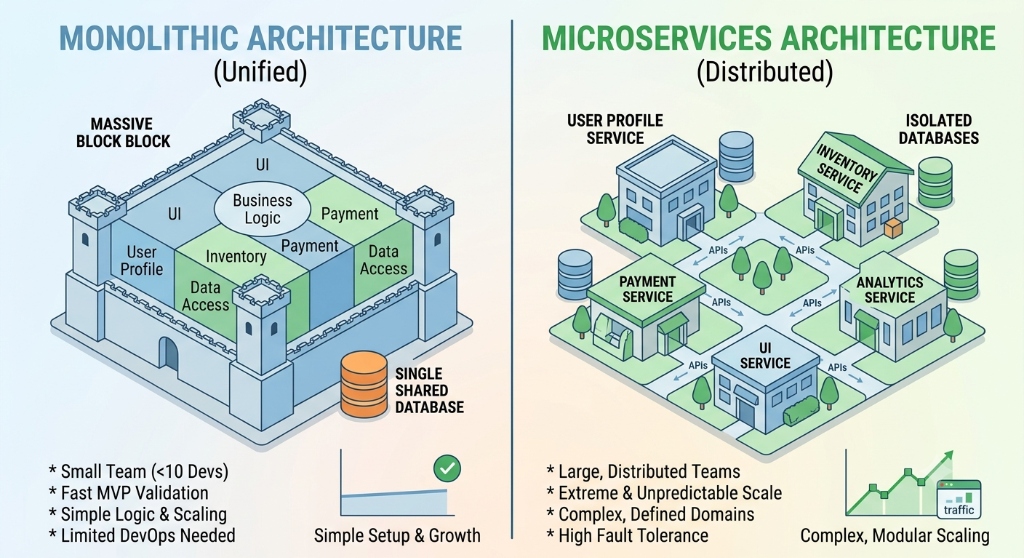
A monolithic application is typically built and deployed as a single application unit. Different business capabilities may exist as separate modules inside the codebase, but they are generally packaged and deployed together.
A well-structured monolith can still have clear boundaries between features. For example, an application might contain separate modules for authentication, employees, payroll, reporting, and notifications while remaining one deployable application.
This approach can make development and deployment relatively straightforward because the application has fewer independently managed services.
What Are Microservices?
Microservices architecture divides an application into multiple independently deployable services. Each service generally focuses on a specific business capability and communicates with other services through defined interfaces.
For example, an application might separate authentication, payments, notifications, reporting, and order processing into different services.
This can provide greater deployment and scaling independence, but it also introduces additional operational and architectural responsibilities.
Monolith vs Microservices: The Core Difference
| Area | Monolithic Architecture | Microservices Architecture |
|---|---|---|
| Deployment | Usually deployed as one application unit. | Services can be deployed independently. |
| Code organization | Modules commonly exist within one application. | Business capabilities are separated into services. |
| Communication | Usually handled through in-process calls. | Services communicate through APIs, messaging, or other network mechanisms. |
| Scaling | Often scales the application as a whole. | Individual services can be scaled independently. |
| Operations | Generally fewer deployable components to operate. | Requires management of multiple services and their interactions. |
| Data | Can use a shared database design. | Services may have separate data ownership and storage patterns. |
| Failure handling | Fewer network boundaries inside the application. | Network failures and partial service failures become important considerations. |
When a Monolith Can Be a Practical Choice
A monolithic architecture can be appropriate when an application is still relatively small, the domain is evolving quickly, or the team wants to keep operational complexity manageable.
A monolith can also be useful when most features need to change together or when the organization does not yet have the operational processes required to manage many independent services.
The important distinction is between a monolith and a poorly structured monolith. A monolithic application can still use clear modules, defined interfaces, automated tests, and strong separation of responsibilities.
When Microservices Can Make Sense
Microservices can become useful when an application contains business capabilities that need different deployment schedules, scaling requirements, technology choices, or team ownership.
However, the architectural benefits come with additional work. Teams need to think about service discovery, communication failures, observability, deployment automation, authentication between services, data consistency, retries, timeouts, and incident handling.
Microservices therefore introduce more than a change in application structure. They introduce a distributed-system operating model.
Do Not Choose Microservices Only Because an Application Is Growing
Application growth does not automatically mean that an application must be split into microservices.
Before creating a new service, identify the specific problem that the separation is intended to solve.
For example:
- Does one part of the application need independent scaling?
- Do different teams need independent ownership?
- Do certain components need separate deployment cycles?
- Is a particular domain becoming difficult to maintain inside the existing application?
- Would separating the component reduce a real operational or organizational constraint?
If these questions do not reveal a concrete problem, adding another service may increase complexity without providing a corresponding benefit.
Start With Business Boundaries
Good service boundaries usually begin with business capabilities rather than technical layers.
Instead of creating separate services for controllers, database access, or generic utilities, identify meaningful business domains within the application.
For example, an e-commerce platform might have domains such as orders, inventory, payments, and customer accounts. The exact boundaries depend on the application's domain and responsibilities.
Clear boundaries make it easier to decide which parts of an application should remain together and which parts might eventually become independently managed.
Consider Team Ownership
Architecture and organization are closely connected. Independent services require teams to understand ownership, deployment, monitoring, incident handling, and dependencies.
If a single small team owns the entire application, splitting it into many services may create additional coordination work.
As organizations grow, independent ownership can become more valuable when teams have clearly defined responsibilities and the engineering processes needed to support them.
Consider Deployment Requirements
One reason organizations consider microservices is the need to deploy different parts of a system independently.
For example, if one business capability changes frequently while another changes rarely, independent deployment can reduce unnecessary releases.
But independent deployment is valuable only when the organization can safely support it. Automated testing, deployment pipelines, monitoring, rollback procedures, and clear service ownership become increasingly important.
Consider Scaling Requirements
Different parts of an application may have different resource requirements.
A monolith can often be scaled by running additional instances of the application. This is straightforward, but it may mean scaling components that do not need additional capacity.
Microservices can allow individual services to scale independently. This can be useful when specific workloads have substantially different requirements.
Scaling should therefore be evaluated from actual workload characteristics rather than architecture trends.
Understand the Cost of Network Communication
In a monolith, communication between modules can often occur inside the same application process. In a microservices architecture, communication frequently crosses a network boundary.
That introduces concerns such as:
- Network latency.
- Connection failures.
- Timeouts.
- Retries.
- Authentication between services.
- Version compatibility.
- Observability across requests.
A service boundary should therefore represent a meaningful architectural boundary rather than simply moving code into another repository.
Think Carefully About Data Ownership
Data is one of the most difficult parts of decomposing an application.
A monolithic application may have multiple modules working with a shared database. When services become independent, teams need to define who owns particular data and how other services can access it.
Cross-service transactions can be more complicated than transactions inside a single application. Data consistency, event handling, retries, and failure recovery may require additional design.
Before splitting a service, identify its data dependencies rather than focusing only on its code dependencies.
Plan for Observability
A distributed application can be harder to troubleshoot because a single user request may pass through several services.
Useful observability practices include centralized logs, application metrics, health monitoring, and request tracing where appropriate.
The goal is to understand what happened across service boundaries when something fails.
Failure Handling Becomes More Important
With multiple services, a failure in one component does not necessarily mean that every other component has failed. This creates both opportunities and challenges.
Applications may need appropriate timeouts, retry policies, fallback behavior, and clear handling of partial failures.
Retries also need careful design. Retrying an operation that is not safe to repeat can create duplicate actions or inconsistent results.
A Practical Decision Framework
Before choosing an architecture, evaluate the application using these questions:
- How large and complex is the current domain?
- Are business boundaries already clear?
- How many teams will own the system?
- Do different parts require independent deployment?
- Do different workloads require independent scaling?
- Can the team operate multiple production services?
- Is automated testing strong enough to support independent releases?
- Are monitoring and logging sufficient for distributed troubleshooting?
- How will service-to-service communication work?
- How will data ownership and consistency be handled?
- What specific problem will splitting the application solve?
The answers should drive the architecture decision rather than the popularity of a particular pattern.
A Gradual Path From Monolith to Services
An application does not have to choose between "one monolith forever" and "many microservices immediately."
A team can start with a modular monolith and establish clear business boundaries. If a particular boundary later needs independent deployment, scaling, or ownership, that module can be evaluated as a candidate for extraction.
A gradual approach can reduce the amount of change introduced at one time and allows the team to learn from the system's actual requirements.
Common Mistakes to Avoid
- Creating microservices before identifying a real problem.
- Splitting services according to technical layers instead of business capabilities.
- Sharing databases between services without clear ownership.
- Ignoring network failures and latency.
- Creating services that must always be deployed together.
- Underestimating monitoring and operational requirements.
- Assuming microservices automatically improve performance.
- Ignoring team size and operational maturity.
Monolith vs Microservices: A Practical Checklist
| Question | What to Evaluate |
|---|---|
| Business boundaries | Are the application's domains clearly separated? |
| Team structure | Can teams own services independently? |
| Deployment | Do components genuinely need independent releases? |
| Scaling | Do workloads require independent scaling? |
| Data | Can data ownership be clearly defined? |
| Communication | Can service dependencies tolerate network failures? |
| Operations | Can the team monitor and operate multiple services? |
| Testing | Can services be tested and released safely? |
| Observability | Can failures be traced across service boundaries? |
| Actual problem | Is there a concrete reason to introduce service boundaries? |