



In digital product development, teams frequently find themselves trapped between two extremes: rigid adherence to textbook design methodologies on one side, and chaotic, unguided ad-hoc builds on the other. A product manager or lead designer reads a handbook on Design Thinking or the Double Diamond, and suddenly every task—regardless of whether it is an exploratory greenfield platform or a minor form adjustment—must pass through identical stages of user interviews, journey mapping, affinity diagramming, and multi-round usability validation.
When process becomes a sacred ritual, deliverables replace outcomes. Teams celebrate finishing fifty-page research decks and polished Figma component libraries, even while the shipped software fails to solve the user's core problem, misses critical deadlines, or introduces technical friction that was never caught in static mockups. True design excellence is measured not by how strictly a team adhered to a formal framework, but by the tangible outcome: does the software enable real people to achieve their goals reliably, intuitively, and efficiently?
Following your own design process means building an adaptive, outcome-focused workflow calibrated to the specific risks, technical constraints, and operational realities of your project. This guide examines why one-size-fits-all methodologies break down, analyzes the trade-offs of major industry frameworks, and provides a structured approach for engineering and product teams to tailor an effective, outcome-oriented design process.
The Deliverable Trap: Confusing Artifacts With Progress
The fundamental hazard in digital design is confusing artifacts with progress. An artifact—whether a persona sheet, journey map, user flow diagram, or interactive prototype—is merely a temporary communication vehicle. Its sole purpose is to reduce uncertainty and align the team on how to build the right software.
Yet in many organizations, artifacts take on an independent life, leading to what industry practitioners call 'design theater':
- Static Personas Treated as Truth: Fictional profiles created during kickoff that are never validated against actual user behavior, yet cited for months to justify subjective aesthetic choices.
- Over-Engineered Discovery: Spending weeks conducting stakeholder interviews and affinity clustering for interface changes where a quick usability test or A/B experiment would resolve the uncertainty in days.
- Figma Polish Before Feasibility: Designers spending dozens of hours refining visual tokens in isolation, only for engineers to reveal during sprint planning that required database queries introduce unacceptable latency or APIs lack necessary fields.
- Late Usability Testing as a Rubber Stamp: Scheduling user testing right before release when code is already written, architectural decisions are locked, and the team has zero appetite to make structural changes.
When an artifact stops answering an open question or preventing a foreseeable defect, continuing to polish it is waste. The skill of a mature team lies not in executing every possible step of a design curriculum, but in knowing which steps are strictly necessary to de-risk the specific problem at hand.
Evaluating Established Frameworks: Scaffolding, Not Scripts
Industry frameworks provide shared vocabulary and conceptual structure for cross-functional teams. However, treating any framework as an inviolable linear script creates friction. Understanding where established models excel—and where they introduce overhead—is essential for tailoring your workflow.
1. The Double Diamond (Design Council)
Codified by the UK Design Council, the Double Diamond outlines four distinct phases across two divergent and convergent cycles: Discover, Define, Develop, and Deliver. The Design Council has since evolved this into the Systemic Design Framework, emphasizing that real-world design challenges require flexible, non-linear adaptation rather than rigid sequential execution. Design Council — Framework for Innovation
Where it excels: Complex, ambiguous domains where the core problem is poorly understood. It forces teams to explore broadly before locking into assumptions.
Where it adds overhead: Routine feature enhancements, technical migrations, or well-understood UX patterns. Running a full divergent discovery cycle to add an export-to-CSV option or refine an address form introduces unnecessary bureaucracy.
2. The Five-Stage Design Thinking Model
Popularized by the Stanford d.school and extensively researched by the Nielsen Norman Group, this framework outlines five iterative modes: Empathize, Define, Ideate, Prototype, and Test. Nielsen Norman Group research emphasizes that these modes are non-linear and interconnected; teams should cycle rapidly between prototyping and testing rather than treating them as waterfall gates. Nielsen Norman Group — Design Thinking 101
Where it excels: Aligning multidisciplinary teams around human empathy and creating space for divergent hypothesis generation.
Where it adds overhead: It frequently understates production engineering constraints, database schema dependencies, performance budgets, and legacy code complexities. Empathy without architectural grounding often yields concepts that look compelling in slides but fail in production.
3. Lean UX and Hypothesis-Driven Iteration
Lean UX replaces comprehensive design specifications with rapid cycles of cross-functional collaboration and experimentation. Teams articulate assumptions as testable hypotheses: "We believe that [doing this] for [these users] will achieve [this outcome]. We will know this is true when we see [this measurable signal]."
Where it excels: Fast-paced SaaS environments, growth experimentation, and teams with mature collaboration between design, product management, and engineering.
Where it adds overhead: Regulated industries or high-compliance applications where contractual specifications, strict accessibility audits, or formal sign-offs are legally mandated before deployment.
A Practical Framework: Calibrating Process to Project Risk
Rather than adopting any single framework wholesale, high-performing teams evaluate each initiative across three core dimensions of risk. The depth of your design process should be directly proportional to the cost of being wrong.
| Risk Dimension | Core Question | When Risk Is High (Scale Process Up) | When Risk Is Low (Scale Process Down) |
|---|---|---|---|
| Problem Risk | Do we understand who the user is and what problem they need solved? | Novel domain, unfamiliar user persona, or conflicting stakeholder goals. Broad qualitative discovery required. | Iterating an existing, heavily used feature with clear feedback. Skip lengthy discovery. |
| Solution Risk | Does our proposed interaction model solve the problem intuitively? | Novel interaction paradigms, complex multi-step workflows, or dense information display. Multi-round usability testing required. | Implementing established interface conventions (e.g., standard e-commerce filtering). Use lightweight wireframes. |
| Execution Risk | What is the technical and financial cost if the released design is flawed? | Mission-critical financial transactions, medical workflows, or core architectural schemas. Heavy validation required. | Marketing pages or low-traffic internal tools that can be adjusted in hours. Rapid deployment and live monitoring. |
By assessing these dimensions before kicking off work, the team makes a deliberate, documented decision about which design activities to mandate and which to bypass.
Matching Prototype Fidelity to the Question Being Asked
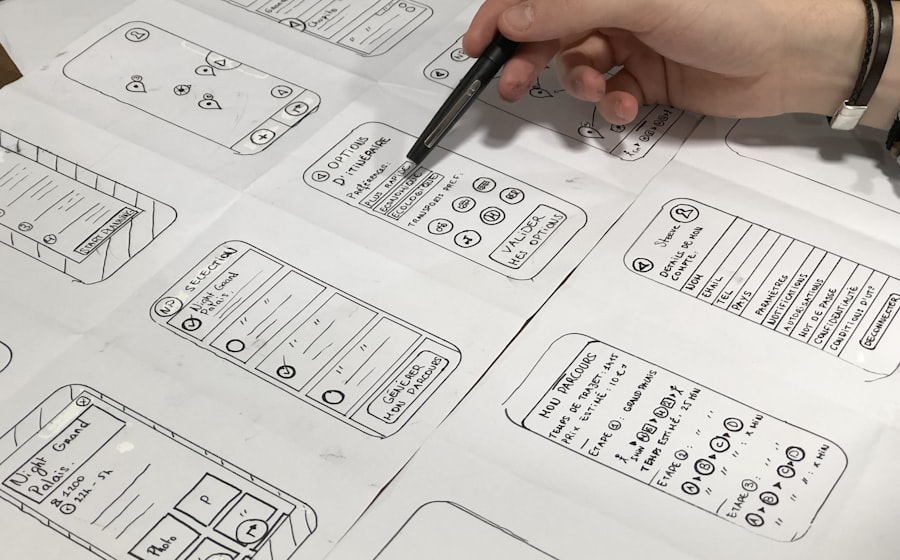
A major driver of wasted effort in product design is using high fidelity too early. Designers often jump straight into vector design tools, building polished mockups with custom illustrations to answer questions that could have been resolved in ten minutes with a marker on a whiteboard.
Fidelity should match the specific hypothesis being tested:
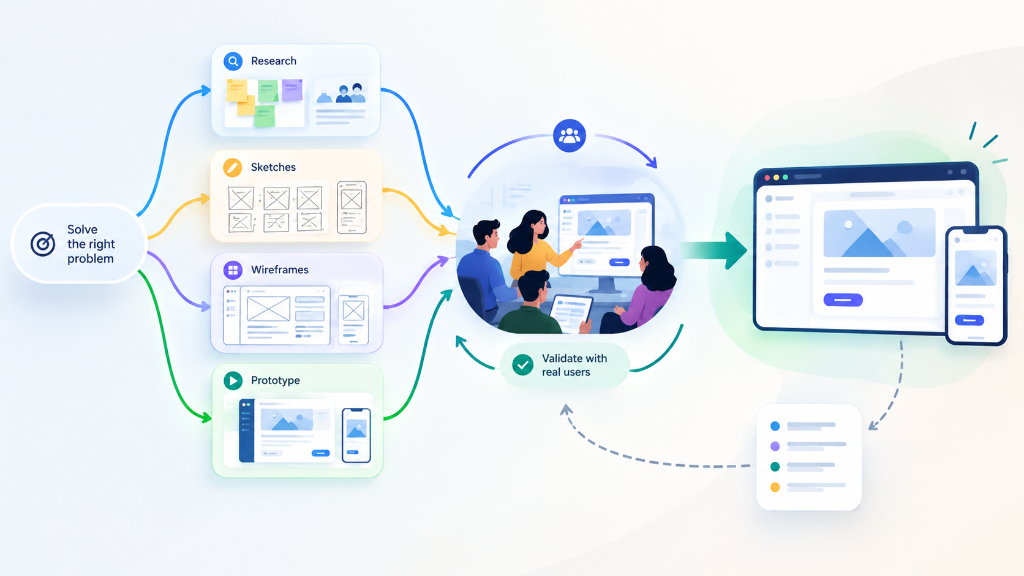
- Sketches and Paper Prototypes: Ideal for conceptual alignment and layout options. Early sketches keep feedback focused on workflow and intent, preventing premature debates over styling.
- Interactive Low-Fidelity Wireframes: Best for evaluating user flows, navigation hierarchy, and transitions. Clickable wireframes quickly expose dead-ends before visual design begins.
- High-Fidelity Component Prototypes: Necessary when evaluating interaction states, visual hierarchy, and micro-copy comprehension, particularly where visual cues directly impact task completion.
- Code-Based Prototypes (HTML/CSS/JS): Essential when testing responsive viewports, keyboard navigation, screen reader accessibility, and dynamic data latency. Testing in the native medium exposes interaction defects that static design tools mask completely. Nielsen Norman Group — Iterative Design of User Interfaces
The Non-Negotiable Foundations: What Never Gets Skipped
Advocating for a flexible, outcome-driven process is not an invitation to abandon discipline. While deliverables, documentation length, and phase boundaries can and should be customized, certain foundational principles must remain non-negotiable across every project:
1. Direct User Feedback Over Internal Opinion
The most dangerous assumption in product development is believing that the product team represents the user. Internal stakeholders possess deep familiarity with company terminology, edge cases, and business logic that external users do not share. Direct observation of real people attempting to complete actual tasks on your interface is the only reliable cure for internal bias.
Even under tight timelines, testing a clickable prototype with just a handful of representative users consistently exposes major comprehension gaps, ambiguous labeling, and broken user journeys before code is committed.
2. Shift-Left Accessibility (WCAG Compliance)
Treating accessibility as a post-launch audit guarantees expensive rework, degraded user experience, and legal exposure. Incorporating the World Wide Web Consortium's Web Content Accessibility Guidelines (WCAG 2.2) from the earliest wireframes ensures that color contrast ratios, focus states, semantic heading structures, and accessible touch targets are built into the design foundation rather than patched on later. W3C Web Accessibility Initiative — Accessibility Fundamentals
3. Continuous Engineering Collaboration
The traditional waterfall handoff—where design completes a static specification and tosses it over the wall to engineering—is the primary driver of delayed sprints and compromised user interfaces. Engineers should participate in early discovery and wireframe reviews. Developers understand technical limitations, API payloads, caching behaviors, and component reuse far better than design tools can simulate. A brief conversation during early wireframing can prevent weeks of redesigning an interface that would have crippled database performance in production.
4. Concrete, Measurable Definition of Done
A design is not complete when the Figma link is delivered to the developer. A design is complete when the implemented software is in production, accessible to users, and verified against defined success criteria. Whether that criterion is reducing checkout drop-off, lowering customer support tickets, or increasing form completion rates, the team must hold itself accountable to the ultimate business and user outcome.
Two Hypothetical Scenarios: Adapting Process in Practice
To understand how an outcome-oriented design process operates in real-world engineering environments, consider two contrasting hypothetical project scenarios.
Hypothetical Scenario A: Enterprise Logistics Dispatch Portal
The Context: A logistics firm needs to replace a legacy desktop tool with a responsive web application used by dispatchers managing hundreds of dynamic vehicle routes daily under intense time pressure.
Risk Profile: High Problem Risk (complex domain rules), High Solution Risk (dense information display with real-time updates), and High Execution Risk (dispatcher errors lead to missed deliveries and contractual penalties).
How the Process Adapts:
- Contextual Observation: Designers conduct contextual inquiry during peak morning hours to observe how physical cheat-sheets, dual monitors, and keyboard shortcuts are utilized in real dispatching conditions.
- Data-Dense Prototyping: Generic wireframes with artificial filler copy ('Lorem ipsum') are strictly avoided. Prototypes are built using realistic dispatch data—including canceled runs and multi-stop delays—to test readability and information density.
- Scenario-Based Usability Testing: Before writing production code, dispatchers execute emergency re-routing workflows on an interactive prototype to measure task completion speed and error rates.
- Outcome Achieved: The final product mirrors the dispatchers' actual cognitive workflow, eliminating reliance on secondary spreadsheets and reducing operational dispatch errors.
Hypothetical Scenario B: B2C E-Commerce Filtering Enhancement
The Context: An online apparel retailer notices that mobile shoppers frequently abandon category pages when attempting to filter products by size, color, and price simultaneously.
Risk Profile: Low Problem Risk (filter interaction is an industry-standard pattern), Moderate Solution Risk (optimizing mobile modal usability), and Low Execution Risk (changes can be deployed behind a feature flag and rolled back instantly if metrics dip).
How the Process Adapts:
- Bypassing Formal Discovery: The team skips extensive discovery workshops, persona creation, and journey mapping. The problem is already defined by analytics drop-off points and customer feedback.
- Rapid Benchmarking & Code Prototyping: The designer and lead engineer spend four hours reviewing mobile filtering paradigms, then build two interactive variations directly in staging within two days using their existing component library.
- Unmoderated Testing & A/B Rollout: Both variations are tested with unmoderated users to confirm comprehension. The winning variation is deployed as an A/B test to 10% of mobile traffic, monitoring conversion rates in real time before full rollout.
- Outcome Achieved: A high-converting mobile filtering experience shipped in less than two weeks, without generating a single unused documentation deck.
The Disposable Artifact Mindset: Documenting Decisions Without Bureaucracy
One of the primary objections to scaling down traditional design documentation is the fear of losing historical context: "If we don't create comprehensive design decks, how will future team members understand why the application was built this way?"
The solution is not to maintain exhaustive, out-of-date wireframe specifications that nobody reads. The solution is to adopt Design Decision Records (DDRs), modeled after Architecture Decision Records (ADRs) widely utilized in software engineering.
A Design Decision Record is a lightweight markdown file created whenever a significant design direction is established or altered. A complete DDR requires only four concise sections:
- Context: What user problem, technical constraint, or business requirement prompted this design decision?
- Alternatives Considered: What other interaction models or layouts were evaluated, and why were they rejected?
- Decision: What design direction was chosen, and what specific evidence (user test results, performance constraints, accessibility requirements) supported the choice?
- Consequences & Trade-Offs: What compromises were accepted (e.g., higher initial implementation effort in exchange for faster subsequent user task completion)?
DDRs take fifteen minutes to write, provide clear accountability, and survive long after disposable Figma drafts have been archived. When a new developer or designer joins the project six months later, reading five concise DDRs provides vastly more actionable insight than wading through hundreds of outdated artboards.
Diagnosing Your Team's Process: Ceremony vs. Substance
If your team feels weighed down by design meetings, endless artifact generation, or repeated post-launch design rework, conduct an honest diagnostic audit using these evaluation criteria:
| Warning Sign (Process Ceremony) | Healthy Pattern (Outcome Focus) | Corrective Action |
|---|---|---|
| Artifacts are evaluated on visual polish rather than problem-solving. | Artifacts are treated as disposable tools to answer specific questions. | Define the explicit hypothesis an artifact must answer before beginning work. |
| Designers work in isolation and hand off specs at sprint end. | Designers and engineers collaborate daily from early discovery through release. | Include engineering in initial problem framing and wireframe sketches. |
| Usability testing is conducted only near release as a formality. | Usability testing is conducted iteratively while changes are cheap to make. | Test with small cohorts (3–5 users) early in the design cycle. |
| Every initiative follows the exact same linear phase gates regardless of risk. | The depth of discovery, prototyping, and testing is scaled based on risk. | Categorize initiatives into High, Medium, or Low risk tiers during planning. |
| Success is measured by screens delivered or story points completed. | Success is measured by task completion rates, error reduction, and business metrics. | Tie design reviews to measurable post-launch product signals. |
This outcome-first philosophy is echoed by leading digital public service institutions. The UK Government Digital Service (GDS), globally recognized for setting standards in accessible digital public services, codifies this in its core principles: "Start with user needs," "Do the hard work to make it simple," and "Iterate. Then iterate again." The GDS guidelines explicitly warn teams against treating process templates as bureaucratic checkboxes, advising practitioners to make prototypes quickly, test them with real users, and discard what does not work. UK Government Digital Service — Design Guidance
Summary: Building Your Team's Design Culture
There is no universal, textbook design process waiting to be discovered. The most effective product teams do not follow an identical sequence of steps; they follow a disciplined, outcome-focused mindset that adapts to the problem in front of them.
To establish this culture on your own projects:
- Prioritize outcomes over artifacts: Never let a wireframe deck, persona card, or design presentation become a substitute for working, usable software.
- Scale rigor to risk: Calibrate the investment in discovery, fidelity, and validation to the potential cost of failure across problem, solution, and execution domains.
- Never compromise on core foundations: Keep direct user feedback, shift-left accessibility, and continuous engineering collaboration non-negotiable.
- Match fidelity to the question: Use the lowest possible fidelity capable of resolving the immediate assumption before investing in high-fidelity polish.
- Document decisions, not ceremonies: Use concise Design Decision Records to preserve rationale and context without encumbering the team with redundant documentation.
By decoupling your team from dogmatic process orthodoxy, you empower designers and engineers to focus their energy where it matters most: delivering software that solves real problems for real people.