


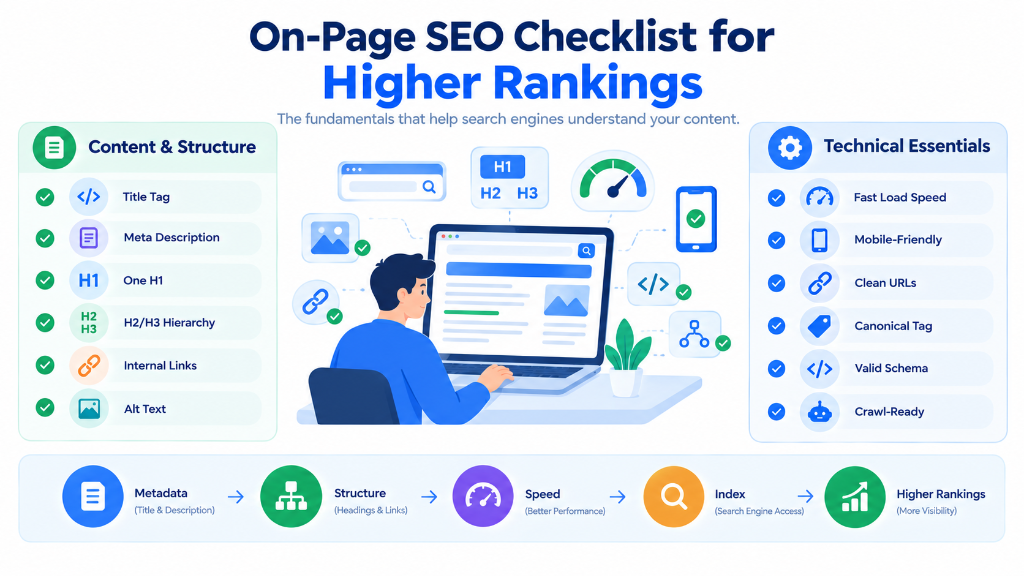

Most on-page SEO checklists list fifteen or twenty items — title tag, meta description, H1, alt text, internal links — as if each one carries roughly equal weight toward ranking higher. That's not how Google's own documentation frames any of this, and treating it that way is how a lot of on-page work ends up checked off without actually changing anything. A more useful checklist separates items into what they actually do: some determine whether a page is even in the running, some help Google understand and prefer the content once it's in the running, and some don't affect rankings at all but change whether people click once your page already shows up.
Tier one: whether the page is a real candidate at all
This tier is about content substance, not markup — the technical side of crawlability and indexability (broken redirects, blocked resources, duplicate URLs) is a separate problem covered elsewhere; the on-page question here is whether what's actually on the page gives Google a reason to consider it a good answer to anything. Google's own guidance on helpful, people-first content is explicit that content produced primarily to attract search traffic, rather than to genuinely help a reader, is the kind of content searchers consistently report as unsatisfying — and that experience, expertise, authoritativeness, and trust are the qualities its systems try to identify.
In practice, this is the item most on-page checklists skip because it can't be reduced to a form field: does this specific page say something a reader couldn't get from the three pages above it in the results, based on real firsthand knowledge of the topic rather than a rephrased summary of what's already ranking? A page that fails this test can have a perfect title tag and still lose to a thinner-looking page that actually answers the question better.
Tier two: signals that help Google understand and prefer the page
Once the content itself clears that bar, a handful of on-page elements genuinely help Google understand what the page is about and match it to the right queries:
- The title element. Google generates the title link shown in search results automatically from page content and other signals, and per its own documentation on title links, it may rewrite a title that doesn't clearly and accurately describe the page — which means a title stuffed with repeated keywords doesn't just look worse to a reader, it can get overridden entirely. A clear, specific, unique title per page does more than a keyword-dense one.
- Heading structure. Headings exist to organize content for the reader (and for anyone using a screen reader), not to hit a target H-tag count. There's no documented benefit to a specific number of H2s or H3s; the actual test is whether someone skimming the headings alone could follow the page's structure.
- Structured data, where it applies. Adding relevant schema markup gives Google explicit clues about what a page represents — a recipe, a product, an event — and can enable a richer result in search, as described in Google's introduction to structured data. Worth flagging directly: Google is clear that structured data helps eligibility for certain search features and understanding, not a ranking boost by itself — it's a distinct benefit, not a substitute for content quality.
- Internal links with descriptive anchor text. Linking to related pages using text that describes the destination — rather than "click here" — helps both readers navigating the site and Google understanding how pages relate to each other.
Tier three: the one that gets misfiled as a ranking factor
The meta description is the item most often placed in the same list as the items above, and it doesn't belong there. Google's documentation on writing snippets describes the meta description as one input Google may use when generating the descriptive snippet under a search result — not a ranking signal. Its job is entirely about the click: whether someone scanning results decides your result is the one that answers their question, once you're already showing up. Writing one that plainly and specifically describes the page is worth doing for that reason alone, and it's worth not conflating with anything that affects whether the page ranks in the first place. A page can have no meta description at all and still rank; it just risks a less compelling, auto-generated snippet instead.
The mistake this framing is meant to prevent
The reason to separate these tiers isn't academic. A team that spends a sprint perfecting meta descriptions and heading counts while the underlying page content is thin has optimized the tier that affects click-through on a page that was never going to rank in the first place. Conversely, a team with genuinely strong, specific content that skips a clear title element is leaving an easy, low-effort improvement on the table. Working through on-page fundamentals in the wrong order is a common reason a page "has good SEO" by every item on a generic checklist and still doesn't move — the checklist was completed, but not in the order that reflects how much each item actually does.
It's also worth being direct about what on-page work can't do on its own: none of the above guarantees a ranking position, and no single tactic here — a rewritten title, an added schema block — moves a page independently of everything else Google's systems weigh, including factors entirely outside the page itself. On-page fundamentals are the part of ranking a page owner has full, direct control over, which is exactly why they're worth getting right before spending effort on things that are harder to control, like earning links from other sites.
Further reading
- SEO Starter Guide: The Basics — Google Search Central
- Creating Helpful, Reliable, People-First Content — Google Search Central
- Influencing Title Links in Google Search — Google Search Central
- How to Write Meta Descriptions — Google Search Central
- Intro to How Structured Data Markup Works — Google Search Central