



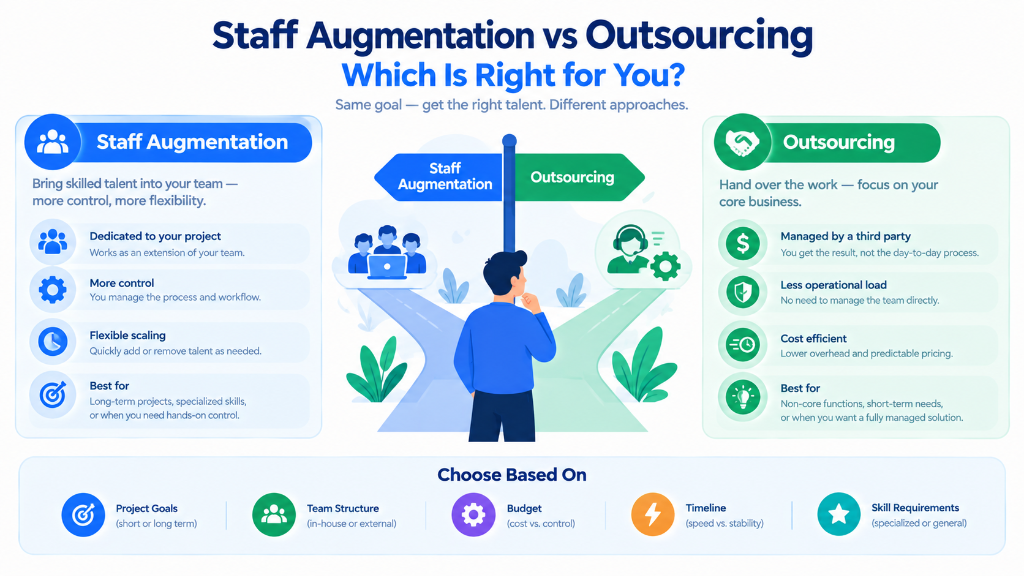

Most comparisons of these two models focus on surface differences — cost, speed, contract length — and leave out the one distinction that actually determines which is right for a given situation: who directs the day-to-day work, and who's accountable for the outcome. That single variable decides not just which model fits, but which legal and management obligations come with it, and it's worth understanding precisely rather than picking based on which term sounds more modern.
The structural difference, stated precisely
In staff augmentation, external people join your team and work inside your existing process — your leads assign their tasks, your standups include them, your definition of done applies to their work. You're renting capacity, and you retain full responsibility for how that capacity gets directed and what it produces. In outsourcing (in the project or managed-services sense), a vendor takes on a defined scope of work and is accountable for delivering the result; they manage their own people, their own methodology, and their own quality process, and you interact with the outcome rather than directing the work that produced it. Everything else people usually list as a difference — cost structure, flexibility, ramp-up time — follows from this one distinction rather than standing independently of it.
Why this distinction has legal weight, not just management preference
This isn't only a project-management question. In the United States, the IRS's own common-law test for worker classification evaluates exactly this factor — behavioral control — as one of three categories used to determine whether someone is functioning as an employee regardless of what the contract calls them. The IRS is explicit that if a business directs or has the right to direct a worker's schedule, tools, and methods of completing the work, that points toward an employment relationship, not an independent-contractor one — and it states plainly that calling someone a contractor in a document doesn't make them one if the actual working relationship says otherwise.
The practical implication: a staff augmentation arrangement that closely mirrors how you manage a direct hire — fixed hours, company equipment, day-to-day task direction from your managers, an indefinite ongoing relationship — sits closer to the employee end of that test than most companies realize, particularly when the individual is engaged directly rather than through a staffing agency that itself employs them. This is a US-specific example of a broader pattern; other jurisdictions run their own version of this same behavioral-control question under different names and different rules, and it's worth having someone check the applicable rule where the work is actually performed, rather than assuming the contract label settles it.
Where staff augmentation is the right fit
Augmentation works well when the gap is capacity or a specific skill, not process or management capability — you already know how you want the work done, you have the technical leadership to direct new people effectively, and you just need more hands executing inside a system that already works. The real cost that's easy to underestimate here isn't the hourly rate, it's the management attention: every augmented person still needs onboarding into your codebase, your review process, and your team's specific conventions, and that ramp-up and ongoing direction is time your existing leads have to spend. A team that's already stretched thin on management bandwidth doesn't fix that problem by adding augmented headcount — it just spreads thinner management attention across more people.
Where outsourcing is the right fit
Outsourcing fits when either the work is well-bounded enough to specify completely upfront, or your organization genuinely lacks the internal expertise to direct the work even if it wanted to — a company with no in-house engineering leadership building its first product, for instance, has no one to manage augmented developers even if it wanted the augmentation model instead. The trade a client makes here is real and worth naming directly: because the vendor owns the how, a client gives up granular control over daily execution in exchange for a single accountable party. That only pays off if the specification going in is genuinely complete, because a vendor delivering against a defined scope treats a mid-project change not as a quick reprioritization but as a renegotiation of what was agreed — which is reasonable from their side, since they priced and staffed the engagement against the original spec.
The mistake that shows up most often
As a hypothetical example: a startup with a product that's still actively evolving — priorities shifting weekly based on user feedback — signs a fixed-scope outsourcing contract because it sounds like the more hands-off, professional option. Three months in, half the original spec is no longer what the product needs, and every adjustment requires a change order and a delay, because the vendor was never set up to absorb that kind of ongoing ambiguity. The same company would likely have been better served by staff augmentation despite the extra internal management overhead, because that model tolerates shifting priorities in a way a scoped deliverable contract structurally can't. The mirror-image mistake is just as common: a company augments its team for a well-defined, bounded piece of work it has no spare management capacity to actually direct, and ends up with billable hours that never quite turn into shipped output because nobody had the bandwidth to point them at anything specific.
The question worth asking before signing either kind of agreement isn't "which is cheaper" or "which is faster to start" — it's whether your organization currently has the internal capacity and process maturity to direct the work day to day. If yes, and the gap is purely people, augmentation is usually the better fit. If no, or the work can be specified completely enough that someone else can own delivering it without your daily input, outsourcing is worth the trade-off in control it requires.
Further reading