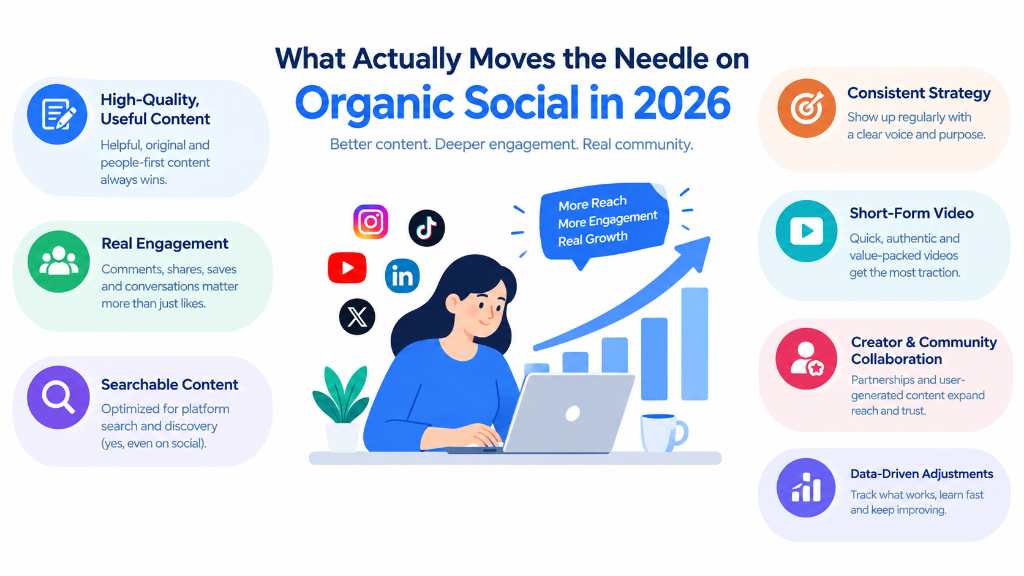





Most social media "strategies" are really just content calendars with a mission statement attached — a list of what to post and when, without an explanation of why doing it that way would ever add up to more than the sum of the individual posts. The word "compounds" is doing real work here: a strategy that compounds is one where each of its parts makes the others more effective over time, rather than three separate to-do lists running in parallel. That only happens if content pillars, consistency, and community management are built to reinforce each other, not managed as three unrelated checkboxes.
Content pillars are a signal-clarity problem, not a topic list
The usual advice is to pick three or four "pillars" — themes a brand posts about — mostly framed as a way to avoid running out of ideas. That's a real benefit, but it's not the main one. Platform recommendation systems build a profile of what an account's content is and who responds to it, and a scattered topic mix makes that profile noisy. Meta's own documentation on how Instagram Feed Recommendations work describes prediction models that rely on signals like how people have engaged with similar content in the past — which only works as a signal if there's enough similar content from an account to establish a pattern in the first place.
As a hypothetical example: a boutique fitness studio posting workout tips, then a staff birthday photo, then a client testimonial, then a local news share, then back to workout tips, never gives either its audience or the platform's systems a stable pattern to learn from. The same studio committing to three consistent pillars — technique breakdowns, client transformation stories, and studio culture — gives every post a chance to reinforce interest built by the last one in the same category, rather than starting over each time. The trade-off to watch for is the opposite failure: too many pillars re-creates the original scattering problem under a more organized-looking spreadsheet, while too few can genuinely exhaust an audience's interest in a narrow theme faster than new content can be produced.
Consistency means something more specific than "post often"
"Be consistent" gets repeated so often it's stopped meaning anything actionable, and it's frequently misread as "post as often as possible." YouTube's own creator guidance pushes back on that reading directly: its documentation on how its recommendation system works recommends prioritizing consistent quality over a high frequency of uploads, specifically because sustained audience engagement — people coming back because a channel reliably delivers on what they expect — is what supports long-term growth, not raw output volume.
The practical version of consistency that actually matters is a dependable cadence a team can sustain without quality dropping, held to for long enough that an audience learns when and what to expect. A brand that posts five times a week for three weeks and then goes quiet for a month has built less of an asset than one that posted twice a week without missing a cycle for six months, even though the second produced less total content. Consistency compounds because it builds a habit in the audience, not because the platform rewards volume for its own sake.
Community management is where the first two pillars either pay off or leak value
Replying to comments and messages is frequently treated as an optional extra layered on top of content production, and — separately from the strategic point here — it's worth knowing that's a distinct job with its own skill set and time demands, not something a content calendar automatically covers. What matters for the strategy itself is that this activity isn't just goodwill; it's a documented input into how future content gets distributed. Meta's Instagram Comments AI system documentation describes ranking signals used to determine which comments and interactions are shown and how they factor into a post's broader engagement profile, meaning conversations happening in a post's comments are part of what the platform reads as evidence the content resonated.
A brand with strong pillars and a reliable cadence that never responds to a comment is leaving the third leg of the compounding effect unbuilt — the audience notices the account doesn't engage back, and the platform's systems have less evidence that the content produced a genuine reaction rather than a passive view. This is also the piece that's hardest to fake or shortcut with better content alone: no amount of production quality substitutes for a real person responding to what the audience actually says back.
Why the three have to move together
The compounding effect described in a strategy like this doesn't come from doing all three at a high level independently — it comes from the interaction between them. Clear pillars without consistency mean the audience-recognition pattern never gets the repetition it needs to form. Consistency without pillars produces a steady stream of content that never builds a legible identity for either the audience or a recommendation system. And either of those without community management stops the loop at broadcasting, never turning a viewer into someone the account has an actual, ongoing relationship with. Each pillar is necessary; none of them is sufficient alone, which is the actual argument for treating this as one strategy instead of three separate workstreams assigned to different people with no shared plan.
A mistake worth calling out directly
Teams often revise a social strategy only when growth stalls, rewriting the content pillars from scratch as if the previous ones failed — when the actual problem was usually that consistency lapsed or community management got deprioritized once someone got busy, not that the topics were wrong. Before rebuilding the pillars, it's worth checking whether the other two legs were ever actually maintained long enough to give the strategy a fair test. A strategy that was never run consistently was never really tested at all.
Further reading