



This comparison assumes the decision to go cross-platform is already made — that's a separate question about whether cross-platform fits your project at all, worth working through on its own before getting here. Once you're choosing between Flutter and React Native specifically, the benchmarks that dominate most comparisons matter less than a structural difference in how each one actually puts pixels on screen, because that difference is what determines how your app behaves as both mobile operating systems keep changing underneath it.
Two genuinely different answers to the same rendering problem
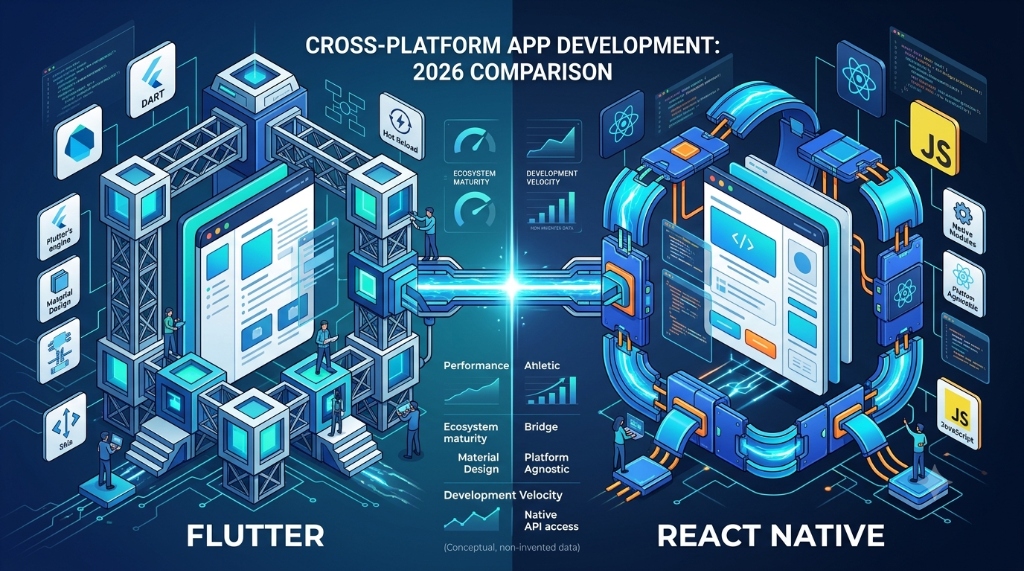
Flutter's own architectural overview describes an approach that bypasses the operating system's native UI widget libraries entirely in favor of Flutter's own widget set, painted directly to the screen using its own rendering engine — Skia or, increasingly, its newer Impeller backend. Nothing about the interface is a native iOS or Android control; Flutter draws every pixel itself, on both platforms, using the same code.
React Native takes the opposite approach. Its Fabric renderer documentation describes a system where React components are mapped to actual native host view instances on each platform — a button in a React Native app is a real native button, rendered by the platform's own UI toolkit, not a repainted approximation of one.
Neither approach is a shortcut or a compromise; both are deliberate, documented engineering choices, and the consequence of the choice matters more day to day than either framework's raw performance numbers.
The consequence that actually shows up over the life of an app
Because React Native's UI is built from real native components, an app inherits whatever the platform's own UI toolkit does when the operating system changes — accessibility behavior, system-level animations, and visual conventions the OS vendor updates are things a React Native app gets automatically, the same way a fully native app would. Because Flutter paints its own widgets, keeping an app's look aligned with a platform's evolving native conventions is work that has to happen at the Flutter framework or widget level, not something that arrives for free the next time a phone's OS updates.
That's not an argument that one approach is better — it's a genuine trade-off. Flutter's model guarantees your app looks and behaves identically on both platforms regardless of what either OS vendor does next, which is exactly what a brand that wants pixel-consistent design across iOS and Android is actually buying. React Native's model means your app ages alongside each platform's native conventions without extra effort, which is what a team prioritizing "feels native" over "looks identical everywhere" is actually buying. Deciding which of those two outcomes your product needs is a more useful exercise than reading a benchmark chart.
The hiring consideration the excerpt promises, stated honestly
Flutter requires Dart, a language most engineering teams haven't used before regardless of their background — the ramp-up is roughly equal for a web developer and a native mobile developer, since neither is starting from existing depth in it. React Native is built on JavaScript or TypeScript, which means a team that already maintains a web product in either language can have engineers contribute to the mobile app without learning a new language, even though mobile-specific concepts (navigation, platform APIs, native modules) still take real time to learn regardless of the language underneath them.
As a hypothetical example: a company with an existing React web app and a team fluent in TypeScript evaluating React Native gets to reuse that language investment directly, even if the actual mobile-specific work — navigation patterns, native module integration — is still new territory for the team. A separate, unrelated hypothetical: a company with no existing web team and a design mandate for pixel-identical branding across every platform, including future ones, has less reason to weight the language question at all, since Dart is equally new to everyone being hired regardless of framework.
Where performance claims deserve more scrutiny than they get
Both frameworks have made deliberate, documented architectural investments specifically aimed at performance: Flutter's Impeller engine was built to address rendering issues like shader-compilation jank that could appear under its previous Skia-only pipeline, and React Native's current architecture replaced its older asynchronous bridge with JSI, a direct interface enabling synchronous communication between JavaScript and native code specifically to remove a known bottleneck in the previous design. Both changes were responses to real, documented limitations in each framework's earlier approach — which is a better reason to expect continued investment in performance from both projects than it is a basis for declaring either one definitively faster today, especially since the answer depends heavily on what a specific app is actually doing.
The question worth asking instead of "which is better"
Given that cross-platform is already the direction, the decision that actually matters is: does this product need identical, brand-controlled visuals regardless of platform evolution, or does it need to track each platform's native feel automatically over time — and separately, does the team already have depth in JavaScript or TypeScript worth preserving, or is everyone starting from zero on the UI language either way. Those two questions, answered honestly, do more to point toward the right choice than any comparison of frame rates or app-size benchmarks that will likely look different again by the next major release of either framework.
Further reading