



The operating environment for online retail has undergone a profound transformation. For much of the past decade, digital storefronts could achieve rapid growth by acquiring traffic through relatively inexpensive digital advertising channels, applying standard conversion rate optimization templates, and scaling top-of-funnel volume. In 2026, that playbook no longer works. Escalating ad costs, privacy-driven signal loss, platform saturation, and cautious consumer spending have compressed merchant margins and exposed the fragility of growth strategies built solely on customer acquisition.
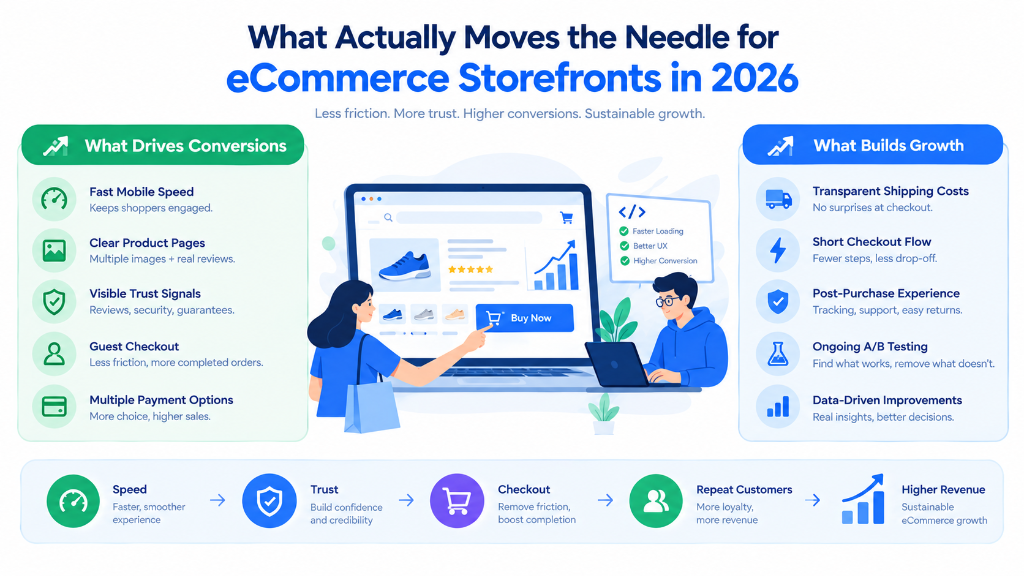
In this climate, superficial storefront modifications—such as restyling a button, adding another urgent countdown timer, or launching an intrusive ten-percent-off discount popup—rarely move the needle. What genuinely drives commercial growth in 2026 is operational and technical excellence: optimizing contribution margins, reducing mobile checkout latency, deploying frictionless payment rails, providing transparent fulfillment data, and building resilient first-party customer relationships.
This guide analyzes the core strategic, technical, and architectural levers that separate resilient, profitable e-commerce brands from those struggling against rising operational headwinds in 2026.
1. The Shift From Gross Revenue to Contribution Margin and Retention
For years, e-commerce leadership prioritized Gross Merchandise Value (GMV) and top-line revenue as their primary performance benchmarks. In 2026, sustainable businesses measure success by contribution margin—the net profit generated per order after deducting customer acquisition costs (CAC), payment gateway fees, pick-pack-and-ship expenses, and the cost of returns.
A storefront generating five million dollars in sales with a forty percent return rate and an eighty-dollar blended CAC often produces far less economic value than a three-million-dollar storefront with disciplined unit economics and high customer lifetime value (LTV). Leading retail operators focus on second-order economics:
- 90-Day Cohort Repurchase Rate: Acquiring a customer who never buys again is rarely profitable under modern advertising costs. The primary driver of profitability is the percentage of customers who place a second order within ninety days.
- Return Rate Mitigation: Product returns are one of the fastest drains on e-commerce profitability, encompassing two-way shipping, warehouse inspection, repackaging, and inventory depreciation. Optimizing product pages to prevent incorrect orders moves the financial needle faster than acquiring more first-time buyers.
- Basket Quality and Cross-Selling: Increasing Average Order Value (AOV) through relevant, context-aware cross-sells (such as warranties, complementary accessories, or bundle discounts) amortizes fulfillment and shipping costs across more revenue.
2. Modern Storefront Architecture: Balancing Speed, Complexity, and Maintenance
Storefront speed is not merely a technical vanity metric; it directly determines whether a mobile visitor completes a purchase or bounces to a competitor. Mobile devices now account for the vast majority of e-commerce web traffic, yet mobile conversion rates consistently lag desktop conversion. A significant portion of that gap is caused by slow storefront rendering, heavy JavaScript bundles, and main-thread responsiveness bottlenecks.
Google's Core Web Vitals establish real-world user experience benchmarks that impact both mobile conversion and search engine visibility. In particular, Interaction to Next Paint (INP)—which measures how quickly an interface updates when a user taps a filter, opens an image gallery, or clicks 'Add to Cart'—has become critical for e-commerce storefronts burdened by dozens of third-party marketing scripts. Web.dev — Core Web Vitals Overview
| Architectural Model | Primary Advantages | Trade-Offs and Considerations | Best Suited For |
|---|---|---|---|
| Modern Monolith (e.g., Shopify Plus / Liquid Themes) | Rapid time to market, built-in checkout security, low engineering overhead, automated hosting and scaling. | Customization constrained by platform APIs; third-party app bloat can degrade frontend performance over time. | Brands prioritizing operational agility and low engineering maintenance without dedicated developer teams. |
| Headless / Composable (e.g., Hydrogen, Next.js Commerce) | Complete control over frontend performance, sub-second edge rendering, customized multi-region user interfaces. | High development and maintenance costs, complex multi-vendor integrations, separate hosting infrastructure. | Enterprise brands with complex omnichannel workflows, multi-country catalogs, and dedicated engineering capacity. |
While composable architectures provide powerful customization capabilities, many mid-sized brands over-engineer their technology stack prematurely. Migrating to a complex headless stack before resolving basic merchandising and fulfillment challenges introduces technical debt that slows feature velocity. In 2026, the winning strategy is choosing an architecture that maintains sub-second page transitions without burying the team in infrastructure maintenance. Shopify Developer Documentation — Storefronts
3. Accelerated Checkout Rails and Frictionless Payment Orchestration
According to extensive empirical research from the Baymard Institute—analyzing millions of data points across global e-commerce checkouts—the average documented shopping cart abandonment rate exceeds seventy percent. When asked why they abandon, consumers consistently cite forced account creation, unexpected fees, and overly complex checkout processes as primary drivers. Baymard Institute — E-Commerce Checkout Usability Research
In 2026, successful storefronts eliminate checkout friction by adopting modern browser payment standards and accelerated digital wallets:
- Browser-Native Payment APIs: Modern browsers support standard payment protocols, such as the W3C Payment Request API, which allows websites to request payment credentials, billing details, and shipping addresses directly from the browser without forcing users to type repetitive form fields. World Wide Web Consortium (W3C) — Payment Request API
- One-Tap Accelerated Wallets: Integrating biometric wallets (Apple Pay, Google Pay, Shop Pay, and PayPal One Touch) directly onto Product Detail Pages (PDP) and cart drawers allows shoppers to bypass the standard checkout flow entirely. Reducing a ten-field checkout form to a single fingerprint or facial scan dramatically reduces mobile drop-off.
- Localized Payment Methods: Expanding internationally requires offering preferred local payment mechanisms (such as iDEAL in the Netherlands, Bancontact in Belgium, or Klarna across Europe). Forcing cross-border customers into an unfamiliar credit card form introduces distrust and high abandonment.
4. Fulfillment Transparency and Reverse Logistics as Conversion Levers
Historically, shipping and fulfillment were treated as back-office logistical concerns that occurred after the purchase was locked in. In 2026, fulfillment transparency is one of the highest-leverage conversion tools on the storefront.
Modern consumers demand certainty before entering payment details. Displaying vague shipping timelines such as 'Standard shipping: 3–5 business days' introduces hesitation. Leading storefronts connect inventory management systems directly to their frontend presentation layers to display dynamic, location-specific delivery promises:
- Real-Time Delivery Estimates on PDPs: Showing 'Order within 3 hours for delivery by Thursday, Oct 12' on the product page removes uncertainty and creates genuine, logistics-backed urgency.
- Transparent Shipping Thresholds: Dynamic progress bars that illustrate exactly how many dollars remain to unlock free shipping increase Average Order Value while preventing surprise fees at final checkout.
- Proactive Sizing and Specification Guidance: Because apparel and footwear categories frequently experience return rates exceeding thirty percent, storefronts that invest in precise measurement guides, customer fit diagnostics, and detailed material specifications substantially reduce returns, directly safeguarding net margins.
5. Structured Search Visibility: Merchant Center Feeds and Schema.org Markup
Search engine optimization for e-commerce in 2026 extends far beyond traditional on-page text. Search engines increasingly surface products directly within rich visual search experiences, shopping knowledge panels, and dynamic price-comparison carousels. To compete, storefronts must provide structured data that search engine crawlers can ingest programmatically.
Implementing comprehensive Schema.org structured data enables search engines to display rich product badges, live pricing, stock availability, and verified customer review counts directly in organic search results. Google explicitly prioritizes structured merchant listings that provide complete product metadata. Google Search Central — E-Commerce Search Guidelines
Essential structured data specifications for modern commercial storefronts include: Schema.org — Product Entity Documentation
- Product and Offer Entities: Defining precise SKU identifiers, brand properties, currency-specific pricing, and availability states (`InStock`, `OutOfStock`, `PreOrder`).
- MerchantReturnPolicy: Formally declaring return windows, restocking fees, and return shipping responsibilities so search engines can highlight customer-friendly policies directly in search listings.
- AggregateRating: Displaying verified customer review scores and review counts directly in SERP snippets to increase organic click-through rates.
6. Zero-Party Data and Personalized Merchandising
The deprecation of third-party tracking cookies and the tightening of global privacy regulations (such as the GDPR in Europe and the CCPA/CPRA in California) mean merchants can no longer rely on external ad platforms to profile their visitors. The most sustainable e-commerce brands in 2026 collect zero-party data—information that customers intentionally and proactively share with the brand.
Instead of relying on passive tracking, storefronts collect explicit customer preferences through interactive digital touchpoints:
- Diagnostic Onboarding Quizzes: Routine fit-finders, skin-type assessments, or product matching tools that recommend tailored product routines while capturing customer preferences.
- Customer Preference Centers: Allowing registered users to specify product preferences, communication frequency, and sizing profiles directly in their account dashboard.
- Automated Replenishment Workflows: Using consumption cycle data to remind customers to reorder consumable products (such as skincare, supplements, or specialty coffee) precisely when their supply is running low.
Zero-party data enables personalized on-site merchandising and email workflows that respect user privacy while dramatically outperforming generic mass-marketing campaigns.
Two Hypothetical Walkthroughs: Applying the 2026 Levers
To understand how these strategic and technical levers operate in commercial practice, consider two contrasting hypothetical retail scenarios.
Hypothetical Scenario A: High-SKU Consumer Goods Brand Optimizing Mobile Conversion
The Challenge: A consumer goods retailer generating sixty percent of its traffic from mobile devices struggled with a mobile conversion rate under 1.2%, despite healthy desktop conversion. An audit revealed seven third-party analytics scripts blocking main-thread interactivity, causing severe Interaction to Next Paint (INP) delays on mobile filters.
Strategic Interventions:
- Frontend Tag Pruning: Removed four legacy tracking scripts and migrated essential analytics to server-side tracking, reducing mobile JavaScript payload by 320 KB and bringing INP below 150 milliseconds.
- Accelerated Wallet Deployment: Positioned Apple Pay and Shop Pay buttons prominently above the fold on mobile product pages, enabling one-tap checkout without page reloads.
- Dynamic PDP Delivery Estimates: Integrated warehouse inventory data to display guaranteed delivery dates based on the customer's geo-located postal code.
- The Result: Mobile checkout completion improved noticeably, reducing cart abandonment and establishing a resilient technical foundation for future seasonal sales spikes.
Hypothetical Scenario B: Specialty Apparel Brand Protecting Net Margins
The Challenge: A specialty apparel brand experienced strong top-line sales growth but saw profitability eroded by a twenty-eight percent return rate, primarily driven by inconsistent sizing and ambiguous fabric descriptions.
Strategic Interventions:
- Interactive Sizing Diagnostics: Replaced static size charts with an interactive sizing recommendation tool that asked customers about their fit preferences and reference brand sizes.
- Structured Return Policy Declarations: Implemented Schema.org `MerchantReturnPolicy` markup and transparent return guidelines on product pages to set clear customer expectations before purchase.
- Targeted Post-Purchase Onboarding: Implemented automated garment-care email sequences that educated customers on fabric maintenance immediately after delivery.
- The Result: Sizing-related returns declined by over thirty percent, preserving substantial gross margin and converting first-time buyers into profitable repeat customers.
Diagnostic Framework: Auditing Your Storefront Growth Levers
Before embarking on costly site redesigns or increasing paid media spend, evaluate your e-commerce storefront against this operational diagnostic framework:
| Growth Dimension | Core Diagnostic Question | Recommended Standard |
|---|---|---|
| Unit Economics | Do you measure net contribution margin per order after CAC, fulfillment, and returns? | Calculate 90-day cohort LTV to determine realistic maximum allowable customer acquisition costs. |
| Mobile Performance | Does your mobile storefront meet Core Web Vitals thresholds (INP < 200ms, LCP < 2.5s)? | Audit JavaScript execution budgets and prune unnecessary third-party tracking scripts. |
| Checkout Friction | Are accelerated biometric wallets (Apple Pay, Google Pay, Shop Pay) available on PDPs? | Allow one-tap purchasing that bypasses multi-step form entry entirely. |
| Fulfillment Transparency | Do product detail pages display dynamic, location-specific delivery promises? | Show exact expected arrival dates rather than vague shipping day ranges. |
| Search Structured Data | Are Schema.org `Product`, `Offer`, and `MerchantReturnPolicy` entities fully validated? | Maintain error-free structured feeds in Google Search Console and Merchant Center. |
| First-Party Intelligence | Do you capture zero-party preferences through quizzes or preference centers? | Collect consented customer preferences to fuel automated replenishment and tailored recommendations. |
Further Reading
- Baymard Institute — Cart Abandonment Rate Research & Benchmarks
- World Wide Web Consortium (W3C) — Payment Request API Architecture
- Google Search Central — E-Commerce Best Practices and Structured Data
- Web.dev — Core Web Vitals and User Experience Benchmarks
- Shopify Developer Documentation — Storefront Performance & Architecture
- Schema.org — Product and Commercial Offer Entity Specifications
Summary: Building a Resilient Storefront for 2026
Success in 2026 e-commerce is not determined by who spends the most on top-of-funnel customer acquisition or who has the flashiest visual design. It is determined by the merchants who build disciplined, high-performance storefronts engineered around customer experience and unit economics.
By focusing on contribution margins over vanity revenue, optimizing mobile Core Web Vitals, deploying browser-native payment rails, communicating fulfillment logistics transparently, and cultivating zero-party customer intelligence, digital retailers can build a defensible, highly profitable commercial engine that thrives regardless of broader market fluctuations.